
Estimated reading time: 10 minutes
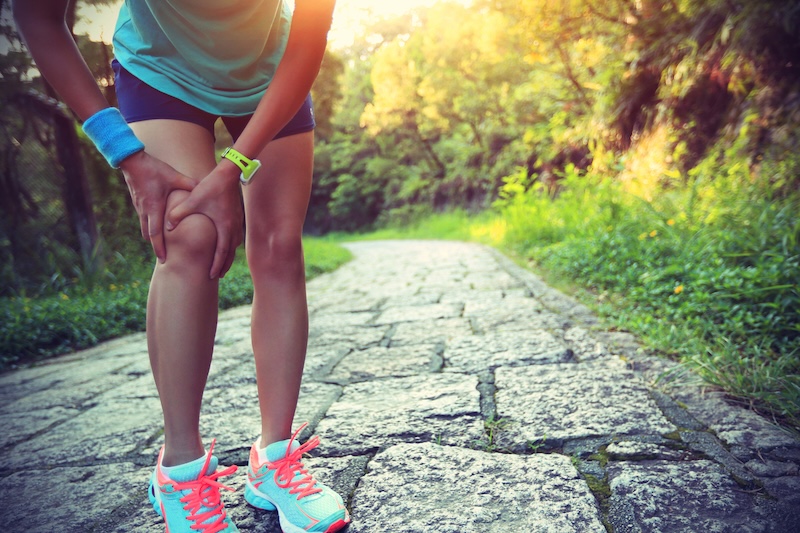
Does your knee start hurting during a run – or feel sore later that day or the next morning?
Knee pain when running can develop for several reasons. Common possibilities include irritation around the kneecap, tendon problems, a sudden increase in training, muscle weakness or fatigue, previous injuries, or changes in how your hip, knee, foot, and ankle are working together.
Sometimes running-related knee pain settles when you temporarily reduce your training. But if the pain keeps returning, is getting worse, or is preventing you from running comfortably, it’s worth finding out what may be causing it.
As an Edmonton chiropractor, I regularly assess runners and other active adults with knee and lower-extremity problems. The goal is to identify what’s contributing to the pain and help you return to running safely and confidently.
What Causes Knee Pain When Running?
There isn’t one single cause of knee pain from running.
The knee has to repeatedly absorb and transfer force with every stride. Your muscles, tendons, joints, hips, ankles, and feet all contribute to controlling those forces.
Most runners tolerate this very well.
Problems can develop, however, when the demands of running temporarily exceed what the knee or surrounding tissues are prepared to handle.
Several conditions and contributing factors may be involved.
Runner’s Knee
Runner’s knee, also known as patellofemoral pain, is one of the most common causes of knee pain in runners.
Pain is usually felt around or behind the kneecap. You may notice it while running, particularly on hills, or during other activities such as climbing stairs, squatting, or sitting with your knee bent for a long time.
Patellofemoral pain can be influenced by several factors, including training load, strength, movement control, and how forces are distributed through the lower extremity.
Because there isn’t always one single cause, determining what appears to be contributing in your particular case is important.
Patellar Tendon Irritation
The patellar tendon connects your kneecap to the shin bone and helps transfer force when you straighten your knee.
Running, jumping, hills, and other repetitive loading can sometimes irritate this tendon.
Patellar tendon pain is generally felt at the front of the knee, often just below the kneecap. It may be particularly noticeable with running, jumping, squatting, or going up and down stairs.
Iliotibial Band-Related Pain
Pain on the outside of the knee in runners is sometimes associated with the iliotibial band, or IT band.
The discomfort may begin after you’ve been running for a certain distance and become progressively more noticeable as you continue.
Training changes, hip strength and control, running volume, and other biomechanical factors may contribute.
Meniscus or Joint Problems
Not all running-related knee pain comes from muscles or tendons.
The menisci are cartilage structures within the knee that help distribute load and contribute to joint function. They can be injured during twisting movements, but meniscal changes can also develop gradually.
Joint irritation or osteoarthritis may also cause knee pain during or after running, particularly in older runners.
This doesn’t automatically mean you have to stop running. The appropriate approach depends on your symptoms, examination findings, activity level, and individual circumstances.
Could My Training Be Causing My Knee Pain?
Sometimes the problem isn’t running itself – it’s a change in how much running your body is being asked to tolerate.
A sudden increase in training can be an important contributor to a running knee injury.
This might include:
- Increasing your weekly mileage too quickly
- Running more frequently
- Adding hills or speed work
- Returning to running after a long break
- Suddenly increasing the length of your long run
- Changing your usual running surface
- Starting a more demanding training program without adequate recovery
This is particularly relevant in Edmonton when runners return outdoors after a long winter or suddenly increase their mileage once the weather improves.
Your cardiovascular fitness may feel ready for the additional distance before your muscles, tendons, and joints have fully adapted to the increased workload.
Can My Spine, Hips, Feet or Ankles Affect My Knee?
They can sometimes contribute.
Your knee doesn’t function independently from the rest of your leg.
The spine, hip, pelvis, knee, ankle, and foot work together every time your foot contacts the ground. Strength, mobility, balance, and movement control throughout this chain can influence how forces are managed during running.
For example, when the spine isn’t mobile the nerves to the muscles around the knee can be compromised decreasing strength, Reduced hip strength or control may affect the movement of the leg during running. Limited ankle mobility or a previous ankle injury may also change how you move.
Foot mechanics may be relevant for some runners as well.
That doesn’t mean every runner with knee pain needs to have their gait “corrected” or requires orthotics. It means that assessing the areas above and below the knee can sometimes provide useful information about why the problem keeps occurring.
What About My Running Shoes?
Running shoes can be part of the picture, but they’re rarely the only thing worth considering.
If your shoes are extremely worn, uncomfortable, or substantially different from what you’re accustomed to, they may affect how running feels.
A recent change in footwear can also coincide with symptoms, particularly if you’ve changed both your shoes and your training at the same time.
However, simply buying a different pair of shoes doesn’t necessarily solve knee pain.
If the pain persists, it’s better to assess the knee and the factors that may be contributing rather than assuming footwear is the entire problem.
Should I Stop Running if My Knee Hurts?
Not necessarily.
Mild discomfort doesn’t always mean you need to stop running completely, but repeatedly running through worsening pain isn’t a good strategy either.
Depending on the problem, you may need to temporarily reduce your distance, frequency, speed, hills, or other activities that aggravate your knee.
Some runners can continue running at a modified level while recovering. Others may benefit from temporarily replacing some runs with activities that are better tolerated.
The important point is that your return to running should be based on how your knee responds rather than simply waiting a predetermined number of days and immediately returning to your previous mileage.
When Should I Have Running-Related Knee Pain Assessed?
Consider having your knee assessed if:
- Pain occurs repeatedly when you run
- Your knee pain is becoming more intense
- The pain is affecting your running distance or pace
- Your knee hurts during everyday activities
- Swelling develops or repeatedly returns
- Your knee catches, locks, or gives way
- You’ve lost knee movement
- You can’t comfortably put weight on the leg
- You’ve changed your running style because of the pain
- Rest helps temporarily, but the pain returns as soon as you start running again
A significant traumatic injury, inability to bear weight, marked swelling, obvious deformity, or other concerning symptoms may require prompt medical assessment.
How Can Chiropractic Care Help With Running-Related Knee Pain?
Assessment begins by determining what appears to be causing your knee pain.
At Collins Chiropractic Health & Wellness Centre, this may include examining your knee as well as relevant areas such as your spine, hips, ankles, foot, and lower back.
Depending on your condition, treatment and rehabilitation may include:
- Improving joint mobility where appropriate
- Improving spine and nerve function
- Improving posture so weight-bearing is more symmetrical
- Addressing muscle and soft-tissue restrictions
- Strengthening exercises
- Balance and movement-control exercises
- Flexibility or mobility exercises
- Gradual progression of activity
- Advice about modifying your running while you recover
The goal isn’t simply to make your knee feel better temporarily.
It’s to restore the movement, strength, and function you need to return to running – and help you build your running workload back to an appropriate level.
Can I Prevent Knee Pain When Running?
Not every running injury can be prevented, but you can reduce unnecessary spikes in stress on your knees and surrounding tissues.
Build your mileage gradually rather than making large increases from one week to the next. Allow time for recovery, particularly when adding hills, speed work, or longer runs.
Strength training can also be valuable for runners, particularly exercises involving the hips, thighs, calves, and trunk.
Pay attention to recurring symptoms. If the same knee starts hurting every time you reach a particular distance or increase your training, repeatedly resting until it settles and then returning to exactly the same workload may simply restart the cycle.
Finding out why the problem keeps returning can be more useful than continually trying to run through it.
Frequently Asked Questions
For most people, running is not inherently bad for the knees. Your body can adapt to the demands of running, and recreational running does not automatically lead to knee damage. Problems are more likely when an injury is present or when training demands exceed what your body is currently prepared to tolerate.
Symptoms don’t always appear immediately. Repetitive loading during a run can irritate a joint, tendon, or other tissue, with soreness becoming more noticeable afterward or the following morning. Recurring knee pain after running is worth assessing if it isn’t improving.
Downhill running can increase the demands placed on the muscles controlling the knee and may aggravate conditions such as patellofemoral pain. If downhill running consistently triggers your symptoms, reducing hills temporarily and determining why your knee is sensitive to that load may help.
A brace may be useful for certain knee problems, but it isn’t automatically necessary for running-related knee pain. Whether a brace is appropriate depends on the type of injury, your symptoms, and the stability and function of your knee.
There isn’t one correct amount of rest for every runner or every knee injury. Complete rest may not always be necessary. The better approach is to determine what is causing your symptoms and gradually adjust and rebuild your activity based on how the knee responds.
Get Help With Running-Related Knee Pain in Edmonton
If knee pain is keeping you from running comfortably or keeps returning whenever you increase your mileage, it may be time to have it assessed.
At Collins Chiropractic Health & Wellness Centre in Edmonton, we’ll assess your knee, look for factors that may be contributing to the problem, and develop a treatment and rehabilitation plan based on your injury and your running goals.
Learn more about our Sports Injury Treatment in Edmonton, or book an appointment with Dr. Collins for a thorough assessment and personalized treatment and rehabilitation plan.
Take the next step toward getting back to running comfortably and confidently.

About Dr. Dean Collins
Dr. Dean Collins has been helping Edmonton patients improve their health through chiropractic care since 1998. With over 30 years of clinical experience, he has worked with patients of all ages, helping them reduce pain, improve mobility, and maintain healthier, more active lives. At Collins Chiropractic Health & Wellness Centre, Dr. Collins focuses on identifying the underlying causes of pain and dysfunction while providing personalized care, education, and practical strategies to support long-term health and wellness.
Learn more about Dr. Collins or book an appointment today.
To learn more about how chiropractor care can help you and your family, read Dr. Collins’ comprehensive guide to chiropractic care: Chiropractic Care for Everyone.
Sign up for our Dr. Collins’ newsletters and blog posts
Sign up Dr. Collins’ newsletters to receive vital information on how to keep your spine and nervous system healthy as well as how to help optimize your health and avoid chronic illness.


Leave a Reply